

Flipside Playing Cards
SCOPE OF SERVICES
Packaging Experience and Print Design
This project began as an exploration of how a familiar object, a deck of playing cards can be reimagined as a designed artefact.
The intention was to treat the cards not just as a game, but as a collectible object that carries personality, detail and narrative through illustration and print.


Challenge
How do you redesign something as universally recognisable as playing cards without losing their function?
The challenge was to introduce a strong visual identity while preserving the clarity and usability of a traditional deck, creating something that feels both playable and collectible.
Story
We began by breaking down the anatomy of a standard deck -numbers, suits, face cards and backs - to understand where intervention was possible and where familiarity needed to be preserved. Early on, we chose Art Deco as a visual reference point for the project, drawn to its geometry, symmetry and sense of elegance.
This influence shaped the way forms, borders and illustrations were constructed. We explored structured layouts, strong lines and balanced compositions, allowing the illustrations to feel expressive while still grounded in a clear system. The process focused on restraint, letting the Art Deco language elevate the deck without overwhelming its function.

System
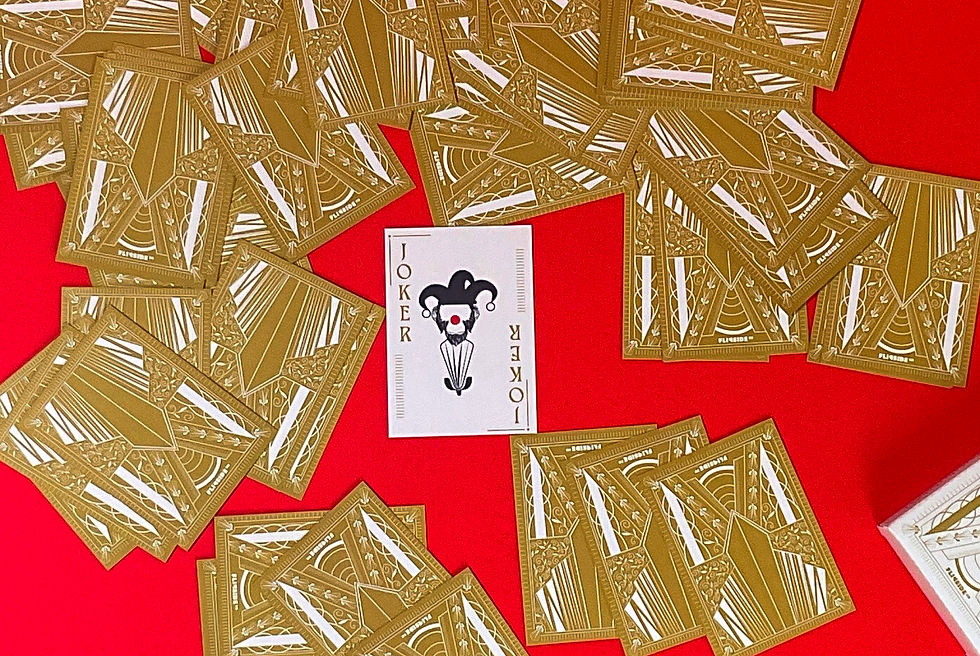
The final system treats the deck as a cohesive visual set rooted in Art Deco principles. Face cards were custom-illustrated with geometric detailing and stylised forms, while number cards followed a consistent, symmetrical structure to maintain clarity and rhythm.


.jpg)
The card backs and packaging extend the same visual language, using pattern, alignment and repetition to create a unified experience. Print finishes and material choices were kept tactile and intentional, reinforcing the idea of the deck as an object meant to be handled, used and kept.
_edited.jpg)


.jpg)